yuhan6665
7103a0cf07
yuhan6665
7103a0cf07
For TLS 1.3, after procesesing the server/client hello, if there isn't a
CCS message, reject the trailing messages which were appended to the
hello messages. This prevents an on-path attacker from injecting
plaintext messages into the handshake.

Additionally, check that we don't have any buffered messages before we
switch the read traffic secret regardless, since any buffered messages
would have been under an old key which is no longer appropriate.

We also invert the ordering of setting the read/write secrets so that if
we fail when changing the read secret we send the alert using the
correct write secret.

Fixes #76443
Fixes CVE-2025-61730

Change-Id: If6ba8ad16f48d5cd5db5574824062ad4244a5b52
Reviewed-on: https://go-review.googlesource.com/c/go/+/724120
LUCI-TryBot-Result: Go LUCI <golang-scoped@luci-project-accounts.iam.gserviceaccount.com>
Reviewed-by: Michael Knyszek <mknyszek@google.com>
Reviewed-by: Daniel McCarney <daniel@binaryparadox.net>
Reviewed-by: Coia Prant <coiaprant@gmail.com>
REALITY
THE NEXT FUTURE
Server side implementation of REALITY protocol, a fork of package tls in latest Go. For client side, please follow https://github.com/XTLS/Xray-core/blob/main/transport/internet/reality/reality.go.
TODO List: TODO
Collect a REALITY NFT to support the development of REALITY protocol!

VLESS-XTLS-uTLS-REALITY example for Xray-core
中文 | English
{
    "inbounds": [ // Server Inbound Configuration
        {
            "listen": "0.0.0.0",
            "port": 443,
            "protocol": "vless",
            "settings": {
                "clients": [
                    {
                        "id": "", // Required, execute ./xray uuid to generate, or a string of 1-30 characters
                        "flow": "xtls-rprx-vision" // Optional, if any, client must enable XTLS
                    }
                ],
                "decryption": "none"
            },
            "streamSettings": {
                "network": "raw",
                "security": "reality",
                "realitySettings": {
                    "show": false, // Optional, if true, output debugging information
                    "target": "example.com:443", // Required, the format is the same as the dest of VLESS fallbacks
                    "xver": 0, // Optional, the format is the same as xver of VLESS fallbacks
                    "serverNames": [ // Required, the acceptable serverName list, does not support * wildcards for now
                        "example.com",
                        "www.example.com"
                    ],
                    "privateKey": "", // Required, execute ./xray x25519 to generate
                    "minClientVer": "", // Optional, minimum client Xray version, format is x.y.z
                    "maxClientVer": "", // Optional, the highest version of client Xray, the format is x.y.z
                    "maxTimeDiff": 0, // Optional, the maximum time difference allowed, in milliseconds
                    "shortIds": [ // Required, the acceptable shortId list, which can be used to distinguish different clients
                        "", // If there is this item, the client shortId can be empty
                        "0123456789abcdef" // 0 to f, the length is a multiple of 2, the maximum length is 16
                    ],
                    "mldsa65Seed": "", // Optional, execute ./xray mldsa65 to generate, for additional post-quantum signature to the certificate
                    // These two limitations below are optional, for rate limiting fallback connections, bytesPerSec's default is 0, which means disabled
                    // It's a detectable pattern, not recommended to be enabled, RANDOMIZE these parameters if you're a web-panel/one-click-script developer
                    "limitFallbackUpload": {
                        "afterBytes": 0, // Start throttling after (bytes)
                        "bytesPerSec": 0, // Base speed (bytes/s)
                        "burstBytesPerSec": 0 // Burst capacity (bytes/s), works only when it is larger than bytesPerSec
                    },
                    "limitFallbackDownload": {
                        "afterBytes": 0, // Start throttling after (bytes)
                        "bytesPerSec": 0, // Base speed (bytes/s)
                        "burstBytesPerSec": 0 // Burst capacity (bytes/s), works only when it is larger than bytesPerSec
                    }
                }
            }
        }
    ]
}
REALITY is intented to replace the use of TLS, it can eliminate the detectable TLS fingerprint on the server side, while still maintain the forward secrecy, etc. Guard against the certificate chain attack, thus its security exceeds conventional TLS REALITY can point to other people's websites, no need to buy domain names, configure TLS server, more convenient to deploy a proxy service. It achieves full real TLS that is undistingwishable with the specified SNI to the middleman
For general proxy purposes, the minimum standard of the target website: Websites out of China's GFW, support TLSv1.3 and H2, the domain name is not used for redirection (the main domain name may be used to redirect to www) Bonus points: target website IP reside closer to proxy IP (looks more reasonable, and lower latency), handshake messages after Server Hello are encrypted together (such as dl.google.com), OCSP Stapling Configuration bonus items: Block the proxy traffic back to China, TCP/80, UDP/443 are also forwarded to target (REALITY behaves like port forwarding to the observer, the target IP may be better if it is an uncommon choice among REALITY users)
REALITY can also be used with proxy protocols other than XTLS, but this is not recommended due to their obvious and already targeted TLS in TLS characteristics The next main goal of REALITY is "pre-built mode", that is, to collect and build the characteristics of the target website in advance, and the next main goal of XTLS is 0-RTT
{
    "outbounds": [ // Client outbound configuration
        {
            "protocol": "vless",
            "settings": {
                "vnext": [
                    {
                        "address": "", // The domain name or IP of the server
                        "port": 443,
                        "users": [
                            {
                                "id": "", // consistent with the server
                                "flow": "xtls-rprx-vision", // consistent with the server
                                "encryption": "none"
                            }
                        ]
                    }
                ]
            },
            "streamSettings": {
                "network": "raw",
                "security": "reality",
                "realitySettings": {
                    "show": false, // Optional, if true, output debugging information
                    "fingerprint": "chrome", // Optional, use uTLS library to emulate client TLS fingerprint, defaults to chrome
                    "serverName": "", // One of the server serverNames
                    "password": "", // The public key generated from the server's private key, for the client it is the password
                    "shortId": "", // One of the server shortIds
                    "mldsa65Verify": "", // Optional, the public key generated from the server's mldsa65Seed, for additional post-quantum verification to the certificate
                    "spiderX": "" // The initial path and parameters of the crawler, recommended to be different for each client
                }
            }
        }
    ]
}
The REALITY client should receive the "Temporary Trusted Certificate" issued by "Temporary Authentication Key", but the real certificate of the target website will be received in the following three cases:
- The REALITY server rejects the Client Hello of the client, and the traffic is redirected to the target website
- The Client Hello of the client is redirected to the target website by the middleman
- Man-in-the-middle attack, it may be the help of the target website, or it may be a certificate chain attack
The REALITY client can perfectly distinguish temporary trusted certificates, real certificates, and invalid certificates, and decide the next action:
- When the temporary trusted certificate is received, the proxy connection is available and everything is business as usual
- When the real certificate is received, enter the crawler mode (spiderX)
- When an invalid certificate is received, TLS alert will be sent and the connection will be disconnected
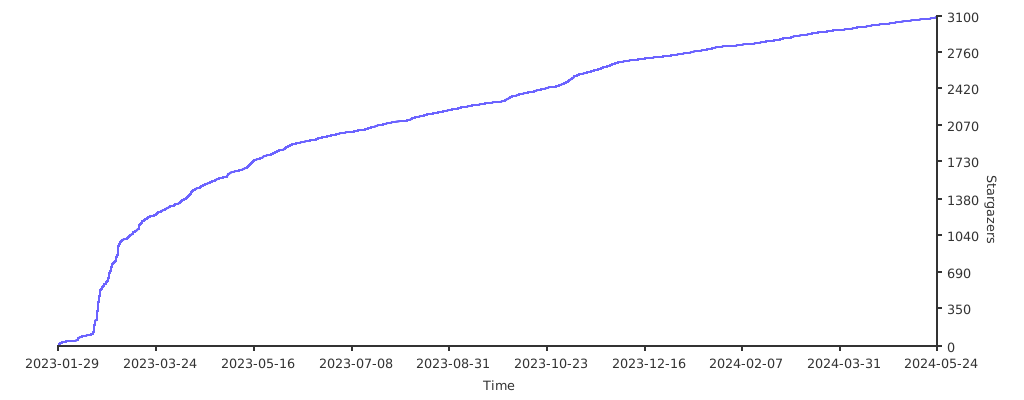
Stargazers over time